
MTB Politics | PDF version of this document | Word doc version of this document
Cessford, G.R. 2002. Perception and Reality of
Conflict: Walkers and Mountain Bikes on the Queen Charlotte Track in New
Zealand.
Extracted from Monitoring and Management of Visitor Flows in Recreational and Protected Areas. Proceedings of the Conference held at Bodenkultur University Vienna, Austria, January 30-February 02, 2002. Edited by Arnberger, A; Brandenburg, C. and Muhar, A. (eds.). Institute for Landscape Architecture and Landscape Management, Bodenkultur University, Vienna.
A version of this paper is also due to be published (late 2002/early 2003) in the Journal of Nature Conservation (in affiliation with the European Centre for Nature Conservation - ECNC). Publishers - Urban & Fisher Verlag, D-07743, Jena, Germany
Monitoring and Management of
Visitor Flows in Recreational and Protected Areas
Bodenkultur University Vienna, Austria
January 30 – February 02, 2002
Arne Arnberger,
Christiane Brandenburg, Andreas Muhar
Institute for Landscape Architecture and
Landscape Management
Bodenkultur University Vienna
Released: January 2002
The editors wish to thank:
Markus Barth, Renate Eder, Ingrid Kletzl,
Thomas Schauppenlehner, Petra Sterl, Sophie Strasser,
Simone Wagner
Perception and Reality of Conflict: Walkers and Mountain Bikes on the Queen Charlotte Track in New Zealand
Gordon Cessford
Science and Research Unit, Department of Conservation, PO Box 10420, Wellington, New Zealand. Email: gcessford@doc.govt.nz
Abstract: A variety of social and physical impacts
are attributed to mountain biking. In many cases, the perception of these
impacts differs from the reality of on-site experiences. This distinction is
explored in two ways. First, a brief review of impact issues associated with
mountain bikes is carried out. Second, results are presented from a survey of
370 walkers on a multi-day natural track where biking has been allowed on a
trial basis. Walker opinions are surprisingly positive toward bikes. These
opinions are found to be more positive among those walkers who had actual
encounters with bikes. By contrast, more negative opinions were found among
those who had no such encounters. Such
distinctions between perception of a conflict and the actual outcome from an
experience have important implications for park managers responsible for
providing a range of different recreation opportunities.
INTRODUCTION
Like most
other government departments managing conservation areas, the Department of
Conservation (DOC) in New Zealand has dual responsibility for protecting
environmental values and allowing appropriate recreational uses. With this
responsibility, the DOC manages almost 30% of New Zealand’s land area, most of
which is, by international standards, highly protected natural environment of
high wilderness quality. Development of roads is not normally allowed, and as a
consequence, recreation use has traditionally been limited to foot access
through an extensive network of backcountry walking tracks and unmarked
wilderness routes.
While
rough surfaces and challenging terrain prevent bike access to most of these
tracks, there are many that could be ridden by very fit and technically
experienced riders. A smaller proportion would be relatively easy to ride by
less experienced riders. These are the types of tracks providing the range of
natural environment and challenging single-track riding experiences most sought
by off-road riders (Cessford, 1995b; Hollenhorst et al., 1995; Hopkin and
Moore, 1995; Goeft & Alder, 2000; Symmonds et al, 2000). The range of
riding opportunities is one of the main reasons that such natural settings have
experienced such biking growth (Hollenhorst et al., 1995). Such spread into a
wider range of previously walking-only tracks is a world-wide trend, and the
issues arising provide similar challenges to park managers everywhere. One of
the main options available to managers has been to incorporate bike use through
allowing shared use tracks. This option is often attractive to managers as it
makes more effective use of existing resources, limits costly replication of
facilities, avoids additional environmental effects from new track development,
and in the case of areas with limited new-development capacity, may be the only
feasible course available. Woehrstein (1998, 2001) notes this latter point is
often the case in Europe for example.
While
national legislation in New Zealand restricts bikes to formed roads in the
national parks, biking is otherwise recognised as a legitimate activity in most
other protected lands. Here the DOC does designate some shared tracks for
walking and biking, where such use does not exceed acceptable levels of social,
physical or ecological impact. A key New Zealand example is the popular Queen
Charlotte Track (refer www.qctrack.co.nz
for description). It is open for walking and biking all year, apart from
partial closure to bikes during the peak-use summer season. Provision for
shared use here has been opposed by some walker advocacy groups, and is
characteristic of recreation conflict situations. This paper explores some of
the impact issues managers face in providing such shared biking/walking tracks,
and reports on a recent survey of walker perceptions of biking on this track.
MOUNTAIN
BIKING IMPACTS
The
variety of reasons people give for disapproving of biking can be summarised in
three types of impact issues. First; from perceptions of physical impacts on
the environment. Second; from social impact perceptions of safety hazards. And
third; from social impact perceptions that biking is inappropriate in many
natural settings (Moore, 1994; Cessford, 1995a; Woehrstein, 1998, 2001; Weir,
2000). Perceptions of these types of impacts lead to conflict between riders,
other track users, and track managers. Based on current knowledge, the
perceptions and realities of these impacts are discussed briefly below,
followed by exploration of a conflict perception example from the Queen
Charlotte Track.
Environmental
Impacts
Environmental
concerns often feature when people discuss problems associated with biking in
natural areas. In a sample of walkers, Horn (1994a) found that 75% considered
that environmental damage from biking was a problem. A similar focus for
concern has been found among park managers, including 35% of those surveyed in
Chavez et al. (1993), and 42% in Chavez (1996a). However, it is important to
note that these impacts have almost always been related directly to the tracks
on which bikes are ridden, rather than on the environments though which the
tracks pass. Like any outdoor recreationists, riders will have impacts on the
environment, including the soils, vegetation, water, and wildlife. But because
most walkers and riders stay on the tracks, wider environmental consequences
are minimal because the direct physical effects are generally confined to the
track surface.
Only in
particular cases may the passage of bikes or walkers result in significant
impact on important environmental features, as opposed to normal wear-and-tear
on tracks. For example, Goeft & Alder (2000) described a case where bikes
were included along with walkers, forestry vehicles and wildlife as potential
vectors by which a particular plant disease could be spread. Woehrstein (1998,
2001) noted that numerous European studies had found little difference in
effects of walkers and bikers on wildlife. And Papouchis et al (2001) found
that bikers had far less disturbance effects on Bighorn Sheep than walkers,
mainly due to walkers more often moving off tracks and surprising or
approaching the animals. To date there appears to be no evidence of bikes
having any more significant impact on important environmental features than
other recreation uses (Cessford, 1995a; Woehrstein, 1998, 2001; Weir, 2000).
Biking
does have an effect on the condition of tracks. These effects are often highly
visually distinctive from those of walking due to the basic differences between
tyre tracks and footprints. Related to this visual perception, the main concern
expressed is that bike tyres create linear channels that may promote runoff and
erosion, as opposed to the puddling caused by footprints (Keller, 1990).
Bjorkman (1996) and others have made extensive investigations that clearly
demonstrated impacts on tracks from bikes, although these were not compared
with those of walkers. What is not clear is the relative significance of bike
and boot impacts on tracks. For park managers, this distinction is particularly
important when they are considering the costs of track maintenance. The usual
perception is that biking has disproportionately higher impact on tracks than
does walking. However, when the comparative effects of different recreation
activities have been investigated, the real differences identified do not
conform to these perceptions.
Comparative
research on track impacts by Weaver & Dale (1978) found that motorbikes had
the greatest effects while going uphill, but that when going downhill, the
effects of horses and walkers were greater. Including bikes, Wilson and Seney
(1994) identified a similar pattern, and noted that lighter and low-powered
bikes had much less track impact potential than motorbikes. And European research
has found that while bikes had greater uphill effects, walkers had greater
downhill effects (Woehrstein 1998, 2001). This draws attention to the basic
distinction between the mechanical effects of rolling wheels and stepping feet
(Cessford 1995a; Weir, 2000), which both have impacts in different ways.
Despite
the general perception otherwise, most available comparative reviews and
studies have concluded that while visibly very different, the physical impacts
of bikes on tracks were not any worse than those of walkers overall (Keller,
1990; Wilson & Seney, 1994; Chavez et al. 1993; Ruff & Mellors; 1993,
Cessford, 1995a; Woehrstein, 1998, 2001; Weir, 2000; Thurston & Reader,
2001;). This appears to be the case whether considering important biological features
or the physical state of the tracks. On this basis, selective restrictions to
biking based on physical impact concerns may be inappropriate. Any physical
impact problems that arise are more likely to be the effects of greater
use-levels overall, or from tracks passing through physically sensitive
environments, particularly related to bad drainage characteristics. Here it
seems that the problem relates more to how biking is generally perceived rather
than the actual effects it may have.
Perceptions
of Safety Hazards
Bikes
are perceived as a hazard when they are considered to be riding too fast for
the conditions (e.g., on crowded, multiple-use trails); not slowing enough when
approaching blind corners; or where they surprise people because they move
quickly and quietly (Moore, 1994; Cessford, 1995a). These are valid concerns
that managers do recognise (Chavez et al. 1993; Chavez, 1996b), and it is
apparent that the behaviour of some riders has posed a hazard. Keller (1990)
noted a number of problems from the reactions of horses to bikes in particular.
With reference to data from an unpublished survey of almost 1500 walkers
(Pettit & Pontes, 1987), both Grost (1989) and Jacoby (1990) noted that
most did not consider bikes were a safety hazard, and in fact characterised
riders as being polite. Jacoby (1990) also noted that only 15 bike encounters
were cited by walkers as potentially hazardous, and the only actual accident
reported involved bikes hitting each other while making way for a walker. From
a survey of 40 resource managers, Chavez et al. (1993) found only one case of
reported walker injury. From 300 accident records, Edger (1997) stated very few
resulted from bike-walker collisions. Almost none of the many thousands of
incidents reported in several years of accident statistics in the German Alps
involved bikes and walkers (Woehrstein, 1998, 2001). And on the Queen Charlotte
track itself, while managers were aware of some accidents, these were all
bike-only (Grose, 2001).
There is
some indication that increased familiarity with biking and accumulated
experience of encounters with bikes may change the hazard perceptions of
walkers (Chavez et al., 1993; Bannister et al., 1992; Horn, 1994; Woehrstein,
1998, 2001). When referring to the Pettit & Pontes (1987), study, Chavez et
al. (1993) noted that negative attitudes by walkers toward bikes remained
constant despite an increase in riding use-levels from 7 to 24% in two years,
and safety issues remained minimal.
While it
does appear that actual safety hazards are over-estimated by walkers, it seems
clear that some will feel uncomfortable knowing that bikes may be present,
whether a real hazard exists or not. Reducing this social impact issue is of
concern to track managers. The real danger from bikes appears to be for their
own riders.
Perceptions
of Social Impacts
Perceived
conflict between walking and biking parallels other widely documented
inter-activity conflicts. As has been apparent for biking, the perceived
impacts of motorised use have similarly emphasised environmental impact and
safety; the appearance, noise, behaviour, presence of mechanisation; and the
inappropriateness of these in natural settings. Implicit in this has been the
assumption that the recreation objectives, environmental attitudes, and values
of these other recreationists are also different.
Inter-activity
conflict research has often found clear differences that reflect these
perceptions, such as those between the recreation preferences and motivations
of snowmobilers and cross-country skiers (Knopp & Tyger, 1973; Butler,
1974; Devall and Harry, 1981; Jackson & Wong, 1982). When both groups are
trying to use the same settings, perceptions of conflict are almost inevitable.
Similar patterns of experience preferences were also reflected in the other
activities in which these groups participated. Given these differences, it was
concluded that such groups would always tend to be in conflict, even when in
different activities and settings. The main question here is if such differences
are represented between walking and biking.
Qualitative
comments made about bikes (e.g. Keller, 1990, Horn, 1994) indicate that for
many walkers (and managers), bikes are conceptually indistinct from motorised
off-road vehicles. The characteristic conflict perception asymmetry, where
walkers perceived bikers more negatively than vice versa, has also been
identified (Watson et al., 1991; Ramthun, 1995; Carothers et al., 2001). Biking
is visually very distinctive. Qualitative comments commonly indicate that the
use of bright cycling clothing and the mechanised appearance of bike and rider
can create conflict perceptions from walkers (e.g. Keller, 1990; Horn, 1994).
In addition, most research profiles of riders (e.g. Cessford, 1995b;
Hollenhorst et al., 1995; Horn; 1994; Ruff & Mellors, 1993; Keller, 1990),
show that riders usually over-represent males and younger ages relative to
walkers. Such obvious visible differences will have had effects on the general
perceptions of biking. However, it is not clear whether these differences are
also reflected in the actual motivations, preferences and environmental
attitudes of riders.
While
some differences are found, the main studies that have compared the attitudes
and preferences of the two groups have found they are more similar than was
perceived. (Watson, et al., 1991, 1997; Horn, 1994; Ramthun, 1995). When Watson
et al. (1991) compared perceptions of similarity with the actual
characteristics, they found that for hikers in particular, the perceptions were
different from the reality. In addition, the degree of asymmetry in these
perceptions was less than anticipated given the characteristic patterns found
in wider conflict research. In follow-up work to the 1991 study, Watson et al.
(1997) found a high proportion of walkers and riders did both activities. In
the European setting where use intensity is higher and bicycle riding in
general is more common, differences between walkers and bikers appear even less
distinct. While restrictions commonly remain on single-track riding, shared
tracks are becoming more common, more walkers are also riding, and perceptions
of conflict appear to be reducing in general (Woehrstein, 1998, 2001; ADFC,
2001;). While comparative research has not been extensive, results suggest that
differences in attitudes and preferences between bikers and walkers are less
than is generally perceived. This inconsistency may diminish as participants
gain greater familiarity with each other. For example, a reduction in conflict
perceptions from 30 to 21% was identified over a 5 year period (Watson et al,
1997).
However,
among the complicating factors that may affect the validity of conflict
perception measures is the possibility that this reduction results in part from
recreation displacement (Bjorkman 1996; Watson et al., 1997). Another is that
the conflict levels reported often exceed those that actually occurred
(Countryside Agency, 2001). And there is also a distinction between conflict
perceptions based on wider social values, and those based on actual
interpersonal encounters in the field. Some of inconsistencies in walker
perceptions of conflict with biking point to such an effect (Carothers et al.,
2001), and the following brief research results provide another example of such
inconsistency.
CONFLICT
PERCEPTIONS ON THE QUEEN CHARLOTTE TRACK
Shared
use of the track was established as a trial. This survey of 370 walkers was
carried out to monitor walkers’ acceptance of this arrangement, and their
opinions about bikes. However, when the walkers who encountered bikes were
distinguished from those who did not, it has also provided useful insight into
the difference between perceived and actual conflict situations. Results
relating to this difference are the main ones reported here.
Satisfaction
and seeing bikes
The most
important primary results for managers were those related to the high levels of
walker satisfaction on the track. In total, 97% of walkers stated they were
totally or mostly satisfied with their visit, and this high level did not significantly
vary according to any walker characteristics or visit experiences. Among these
visit experiences were encounters with bikes. These results indicated that
walkers who encountered bikes were no less satisfied with their visit were
those who did not. Reinforcing this, when walkers who encountered bikes were
specifically asked if these bikes caused them dissatisfaction in any way, 88%
indicated that they did not. And when walkers who did not expect to encounter
bikes were asked if they might have changed their trip plans had they known,
92% said that they would have come to the track anyway.
Overall,
these represent very positive results for this management arrangement. However,
in acknowledgement that overall satisfaction scales are often coarse measures,
some additional evaluative questions were asked of all walkers. Firstly, they
were asked if seeing bikes had, or would have, affected their enjoyment of the
track. Bikes were reported as having no actual or anticipated effect on
enjoyment by 69% of walkers, as having positive enhancing effects by a further
10%, and having negative detracting effects by the remaining 21%. While these
are highly positive results for the shared track approach, the notable
proportion of people feeling bikes had or would have detracted from their
experience does require management consideration.
Who
perceived conflicts with bikes?
To
improve understanding of the conflicts walkers have with bikes, additional data
analysis was carried out on these enjoyment perceptions. This was done using a
classification tree approach suitable for the primarily categorical data
generated from the survey (D’eath & Fabricus, 2000), which in this case
comes from the AnswerTree application
associated with SPSS 10. Figure 1 was
generated from this application, and represents a map of significant
relationships between variables. The effect of bikes on walker enjoyment was
the target variable, and notable variations in response were identified.
Figure 1:Factors influencing how bikes affected track
visit enjoyment
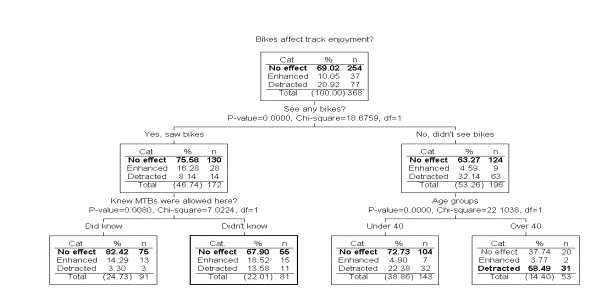
Most
variation was related to whether walkers had encountered bikes on the track or
not (Figure 1). Surprisingly, the more negative perceptions of bikes came from
walkers who had not encountered any (32%). This reflects the distinction
between perceptions based on wider social values and those based more on actual
interpersonal encounters in the field, as described by Carothers et al. (2001).
Among
those not encountering bikes, this negative effect was strongest among the
older walkers (58%). Among those who did encounter bikes, the negative effect
(14%) was greater among those not expecting to see them there. While omitted
from Figure 1 due to space constraints, it is notable that among those not
expecting to see bikes, the negative effect (24%) was again stronger for the
older walkers than the younger (8%).
This
gives managers a clear message that many of the social conflict issues
surrounding bikes on this track are based on perceptions about meeting bikes,
which appear to be different from the reality of experiencing them. In
addition, a specific group of older walkers appear more inclined to hold these
negative perceptions. These key distinctions were reinforced when specific
opinions about bikes were explored.
Conflict
perception issues
Walkers
were asked to indicate their level of agreement with a set of characteristic
opinion statements commonly made in association with bike conflict issues
(Table 1). These results are largely self-explanatory, and show that opinions
both for and against biking varied considerably among walkers. The strongest
responses were the 74% of walkers who considered most problems came from a few
irresponsible riders, the 60% who disagreed that biking should be banned on the
track, and the 58% who disagreed that biking and walking have similar track
impacts. The latter is a particularly interesting example of the power of
perception, when it appears that research has not established any notably
greater effects from bikes on tracks. What is apparent on wet tracks with
poorly consolidated surfaces is that the visibility of tyre-tracks is much
higher than that of boot-prints. In that situation, attributing greater impacts
to bikes is not surprising, even if it may be somewhat misplaced.
Table 1: Walker opinions on biking (Chi² test
significance - * p<.05, ** p<.01 ***p<.000)
|
Common opinions on biking |
Agree |
Neutral |
Disagree |
Compared by encounters with bikes |
Compared by age-group |
|
Biker
behaviour |
|
|
|
|
|
|
Bikers are reckless and go
past walkers too fast |
29 |
27 |
44 |
***Not seen - agree more |
***>40 - agree more |
|
Bikers are reckless and go
round corners too fast |
27 |
36 |
37 |
*** Not seen - agree more |
***>40 - agree more |
|
Only a few irresponsible
riders cause most problems |
74 |
18 |
8 |
- |
- |
|
People over-estimate danger
to walkers from bikes |
38 |
36 |
26 |
- |
- |
|
People over-estimate conflict
between bikers/walkers |
42 |
41 |
17 |
- |
- |
|
Biker
characteristics |
|
|
|
|
|
|
Bikers and walkers are
different sorts of people |
23 |
25 |
52 |
- |
***>40 - disagree more |
|
Walkers are more interested
in the environment |
41 |
22 |
37 |
- |
***>40 - agree more |
|
Bikers are louder and noisier
than walkers |
28 |
21 |
51 |
- |
*>40 - agree more |
|
Bike
management |
|
|
|
|
|
|
Biking and walking have
similar impact on tracks |
25 |
17 |
58 |
- |
- |
|
As bikers learn better
behaviours, conflicts will reduce |
52 |
34 |
15 |
- |
- |
|
As people get used to bikes,
conflicts will reduce |
40 |
32 |
28 |
**Seen -agree more |
*>40 - disagree more |
|
Shared tracks for walking and
biking won’t work |
25 |
25 |
50 |
***Not seen - agree more |
***>40 - agree more |
|
Biking should be banned on
the Queen Charlotte |
18 |
22 |
60 |
***Not seen – agree more |
***>40 - agree more |
While
many of these responses may be encouraging to park managers considering
provision of shared-track approaches, notable proportions of negative opinions
are apparent. Almost 30% considered that bikes go too fast when passing people
or going around corners. A notable minority (23%) considered bikers and walkers
were different kinds of people, while a majority (41%) considered walkers were
more interested in the environment. As briefly noted earlier, these types of
negative perceptions of behaviour and inter-group differences are the
foundation for wider conflict perceptions. They are therefore important areas
for improved management understanding and practice.
Acknowledging
this need, it is notable that, as with overall visit evaluations, there was
also distinct variation in opinions according to age, and to the occurrence of
bike encounters (Figure 2). Those walkers who had encountered bikes on the
track had more positive opinions about them in general. For example, walker
opinions about hazard from bikes going too fast were less negative among those
who actually met bikes. And opinions about biking were consistently more
negative among those walkers over 40. This again draws attention to the
distinction apparent between the evaluations of biking made according to
perceived and actual situations, and to the consistently more negative
perceptions of older walkers about bikes.
MANAGEMENT
CONCLUSIONS
The
emerging conclusions from research on bike impacts, and the largely positive
evaluative results from specific surveys such as that on the Queen Charlotte
Track, suggest a positive outlook for developing shared tracks. It seems that
the perceptions and realities of impacts can sometimes be quite different, and
that greater awareness and experience can lead to a reduction in problem
perceptions. The generally more positive perceptions among those who actually
encountered bikes suggests that some ‘encounter-effect’ may occur that somehow
results in reduced negative feelings. This may reflect some unanticipated
positive aspect from experiencing bikes and their riders, such as friendly
contact, and riding behaviour that was less threatening than expected. Or, it
may reflect some form of conciliatory coping response by visitors when faced
with perceived conflict situations, as widely documented in conflict
literature. Some caution is required regarding possible displacement effects on
the more ‘bike-sensitive’ walkers, such as the older walkers on the Queen
Charlotte Track. All of these possibilities suggest fundamental and important
research questions for managers to address if considering shared-track options.
There is
a general need to ensure people are aware that bikes are likely to be
encountered, and that biker behaviour is appropriate and friendly. The efforts
of biking advocates to promote positive riding and encounter behaviours through
codes of conduct would appear to be very appropriate. How these strategies may
affect walker perceptions of biking over time represent another important area
of research. Managers who are concerned about the notable proportion of walkers
feeling that bikes detract from their enjoyment should be concentrating
attention on the needs and concerns of older walkers, and how this might change
as they are succeeded by the younger generation.
Given
the emerging understanding of the differences between the perceptions and
realities of conflict, opting to provide for shared tracks will require managers
to become more proficient at conflict management processes. Emphasis will be
required on the types of indirect (education, information) and bridge-building
(co-operation, volunteerism) approaches described by Moore (1994), Chavez
(1996) and others.
REFERENCES
ADFC,
2001. Mountainbiking: Ein Leitfaden für Planer, Touristiker und Biker.
Allemenigner Deutscher Fahrrad-Club. Bremen.
Bannister,
C., Groome, D., & Pawson, G. (1992): The Shared Use Debate: a Discussion on
the Joint Use of Canal Towing Paths by Walkers, Anglers and Cyclists. Journal
of Environmental Management, Vol. 34, 149-158.
Bjorkman,
A.W. (1996): Off-Road Bicycle and Hiking Trail User Interactions: A Report to
the Wisconsin Natural Resources Board. Wisconsin Department of Natural
Resources, Bureau of Research.
Butler, R.W. (1974): How to
Control 1000 000 Snowmobilers. Canadian Geographical Journal, Vol. 88, No. 3,
4-13.
Carothers, P; Vaske, J.J., &
Donnelly, M.P. (2001): Social Values versus Interpersonal Conflict among Hikers
and Mountain Bikers. Leisure Sciences, Vol, 23, No. 1, 47-61.
Cessford,
G.R. (1995a): `Off-Road Impacts of Mountain Biking: A Literature Review and
Discussion.' Science and Research Series No. 92. Science and Research Division.
Department of Conservation. (see www.imba.com/resources)
Cessford,
G.R. (1995b): `Off-Road Mountain Biking: A Profile of Participants and their
Recreation Setting and Experience Preferences.' Science and Research Series No.
93. Science and Research Division. Department of Conservation.
Chavez,
D.J. (1996a): Mountain Biking: Direct, Indirect, and Bridge Building
Management. Journal of Park and Recreation Administration, Vol. 14, No.4,
21-35.
Chavez,
D.J. (1996b): Mountain Biking: Issues and Actions for USDA Forest Service
Managers. Res. Paper PSW-RP-226. Albany, CA: Pacific Southwest Research
Station, Forest Service, U.S. Department of Agriculture.
Chavez,
D.J., Winter, P.L., & Baas, J.M. (1993): Recreational Mountain Biking: A
Management Perspective. Journal of
Parks and Recreation Administration, Vol. 11, No. 3, 29-36.
Countryside
Agency (2001): How People Interact on Off-Road Routes. Research Notes CRN 32.
The Countryside Agency.
De’ath, G. & Fabricus, K.A.
(2000). Classification and Regression Trees: A Powerful yet Simple Technique
for Ecological Data Analysis. Ecology, Vol. 81, No. 11, 3178-3192.
Devall,
W. & Harry, J. (1981): Who Hates Whom in the Great Outdoors: The Impact of
Recreational Specialisation on Technologies of Play. Leisure Sciences, Vol. 4,
No. 4, 399-418.
Edger, C.O. (1997). Mountain
Biking and the Marin Municipal Water District Watershed. Trends, Vol. 34, No.
3, 5-10.
Goeft,
U. and Adler, J. 2000. Mountain Biker Rider Preferences and Perceptions in the
South-West of Western Australia.
CALMScience Vol. 3, No. 2: 261-275.
Grose,
R. (2001), pers. com. - Area Manager, Sounds Area Office, Department of
Conservation (Queen Charlotte Track).
Grost,
R. (1989): Managing the Mountain Bike.
American Forests, Vol. 95, 50-53, 75-77.
Hollenhorst,
S., Schuett, M.A., Olson, D., & Chavez, D. (1995): An Examination of the
Characteristics, Preferences, and Attitudes of Mountain Bike Users of the
National Forests. Journal of Park and Recreation Administration, Vol. 13, No.
3, 41-51.
Hopkin,
T.E. & Moore R.L. (1995): The relationship of recreation specialization to
setting preferences of mountain bicyclists. Journal of Leisure Research, Vol.
14, No. 1, 47-62.
Horn,
C. (1994). Conflict in Recreation: the Case of Mountain-Bikers and Trampers.
Unpublished Masterate thesis, Department of Parks, Recreation and Tourism,
Lincoln University, Canterbury, New Zealand.
Jackson,
E.L. & Wong R.A.G. (1982): Perceived Conflict between Urban Cross-Country
Skiers and Snowmobilers in Alberta. Journal of Leisure Research, Vol. 14, No.
1, 47-62.
Jacoby,
J. (1990): Mountain Bikes: A New Dilemma for Wildland Recreation Managers? Western Wildlands, Vol. 16, 25-28.
Keller,
K.J.D. (1990): Mountain Bikes on Public Lands: A Manager's Guide to the State
of Practice. Bicycle Federation of America. Washington D.C.
Knopp,
T. & Tyger, J. (1973): A Study of Conflict in Recreational Land Use:
Snowmobiling vs Ski-Touring. Journal of
Leisure Research Vol. 11, No. 4, 317-326.
Moore,
R.L. (1994): Conflicts on Multiple-Use Trails: Synthesis of Literature and
State of the Practise. Report No. FHWA-PD-94-031, Washington, D.C. Federal
Highway Administration. (see www.imba.com/resources).
Papouchis,
C.M. Singer, F.J. & Sloan W.B. (2001): The respnses of Desert Bighorn Sheep
to increased human recreation. Journal of Wildlife Management, Vol. 65, No. 3,
573-582.
Pettit,
B. & Pontes, P. (1987): Kepner-Trego Analysis – unpublished reports
prepared for the US Forest Service (Santa Barbara Ranger District, Los Padres
National Forest).
Ramthun,
R. (1995): Factors in User Group Conflict Between Hikers and Mountain Bikers.
Leisure Sciences Vol. 17, 159-169.
Ruff,
A.R. & Mellors, O. (1993): The Mountain Bike - the Dream Machine? Landscape Research, Vol. 18, No. 3, 104-109.
Symmonds,
M.C., Hammitt, W.E. & Quisenberry, V.L. (2000): Managing Recreational Trail
Environments for Mountain Bike User Preferences. Environmental Management, Vol.
25, No. 5, 549-564-71.
Thurston,
E. & Reader, R.J. (2001): Impacts of Experimentally Applied Mountain Biking
and Hiking on Vegetation and Soil of a Deciduous Forest. Environmental
Management, Vol. 27, No. 3, 397-409.
Watson,
A.E., Williams, D.R. & Daigle, J.J. (1991): Sources of Conflict Between
Hikers and Mountain Bike Riders in the Rattlesnake NRA. Journal of Parks and Recreation
Administration, Vol. 9, No. 3, 59-71.
Watson,
A., Asp, C., Walsh, J. & Kulla, A. (1997): The Contribution of Research to
Managing Conflict among National Forest Users. Trends, Vol. 34, No. 3, 29-35.
Weaver,
T & Dale, D. (1978): Trampling Effects of Hikers, Motorcycles and Horses in
Meadows and Forests. Journal of Applied
Ecology, Vol. 15, 451-457.
Weir,
D.V. (2000): A Guide to The Impacts of Non-Motorized Trail Use. Donald V. Weir
and Associates, Edmonton, Canada
Wilson,
J.P. & Seney, J.P. (1994): Erosional Impact of Hikers, Horses, Motorcycles
and Off-road Bicycles on Mountain Trails in Montana. Mountain Research and Development, Vol. 14, No. 1, 77-88.
Woehrstein,
T. (1998), Mountainbike und Umwelt.
Verlag, Pirrot & Druck, Saarbrücken.
Woehrstein,
T. (2001), pers. com. about translations of his book - Woehrstein, (1998).
(Acknowledgement
- Claudia Kling, then working at Sounds Area Office, carried out fieldwork and
data entry for the survey, and provided a preliminary data report to track
managers).
Conference Proceedings -
Table of Contents
Preface by Arne Arnberger, Christiane Brandenburg, Andreas Muhar............................................................................... I
Opening address by Günter Liebel, Federal Ministry of Agriculture, Forestry, Environment and Water Management III
*** Keynote
address
Monitoring
Methods
***Methods for Visitor Monitoring in Recreational and Protected Areas: An Overview.
Andreas Muhar, Arne Arnberger and Christiane Brandenburg........................................................................................... 1
Visitor Structure of a Heavily Used Conservation Area: The Danube Floodplains National Park, Lower Austria.
Arne Arnberger and Christiane Brandenburg...................................................................................................................... 7
Developing New Visitor Counters and Their Applications for Management.
Gordon Cessford, Stuart Cockburn and Murray Douglas................................................................................................ 14
Predicting Transgressions of the Social Capacity of Natural Areas.
Sjerp de
Vries and Martin Goossen.................................................................................................................................. 21
GIS - Supported Network Analysis of Visitor Flows in Recreational Areas.
Beate Hinterberger, Arne Arnberger and Andreas Muhar................................................................................................. 28
Spatial Requirements of Outdoor Sports in the Nature Park Southern Blackforest - GIS-based Conflict Analysis and Solutions for Visitor Flow Management.
Alexander Krämer and Ralf Roth...................................................................................................................................... 33
Observation as a Technique for Establishing the Use made of the Wider Countryside: A Welsh Case Study.
Ian Keirle........................................................................................................................................................................... 40
Understanding Visitor Flows in Canada's National Parks: The Patterns of Visitor Use Study in Banff, Kootenay, and Yoho National Parks.
Dave McVetty.................................................................................................................................................................. 46
Monitoring Low Volume Walker Use of a Remote Mountain Range: A Case Study of the Arthur Range, Tasmania, Australia.
Sue Rundle......................................................................................................................................................................... 53
Monitoring of Recreation-Affected Forest Stands in the National Park Losiny Ostrov.
Mark S. Shapochkin and Vera Kiseleva............................................................................................................................ 59
Recreation Monitoring at the Dutch Forest Service.
Peter A. M. Visschedijk and Renè J. H. G. Henkens........................................................................................................ 65
Visitor Management by Visitor Monitoring? Methodological Approach and Empirical Results from the Wadden Sea National Park in Schleswig-Holstein.
Christiane Gätje, Andrea Möller and Mathias Feige......................................................................................................... 68
Conflicts
Between Nature Conservation and Recreational Goals
Tourism Infrastructure Planning in Tusheti National Park of Georgia.
Ramaz Gokhelashvili, Alexander Gavashelishvili, Zurab Javakhishvili and Lela Azniashvili.......................................... 74
The Visitor Flows and the Bird Communities in the Paklenica National Park, Croatia (between 1997-2001).
Gordan
Lukac.................................................................................................................................................................... 78
Visitor Management in the Wilderness Area Dürrenstein, Lower Austrian Kalkalpen.
Reinhard Pekny and Christoph Leditznig......................................................................................................................... 84
Actual Numbers and Effects of Recreational Disturbance on the Distribution and Behaviour of Greylag Geese (Anser Anser) in the ”Neusiedler See – Seewinkel” National Park Area.
Wolfgang
Steiner and Rosemarie Parz-Gollner.................................................................................................................. 89
Integrating Tourism and Grouse Habitat Protection in the Black Forest.
Rudi Suchant and Andreas Schäfer.................................................................................................................................... 95
User
Conflicts
***Perception and Reality of Conflict: Walkers and Mountain Bikes on the Queen Charlotte Track in New Zealand.
Gordon Cessford............................................................................................................................................................. 102
Resolving Inter-Group Conflict in Winter Recreation: Chilkoot Trail National Historic Site, British Columbia.
Siobhan A. Jackson, Wolfgang Haider and Tom Elliot.................................................................................................... 109
Modelling of
Visitor Behavior
***Stated Preference & Choice Models – A Versatile Alternative to Traditional Recreation Research.
Wolfgang
Haider.............................................................................................................................................................. 115
Segmentation of Outdoor Recreationists: A Comparison of Recreationists' Perceptions of Importance and Satisfaction Across Activities.
Robert C. Burns and Alan R. Graefe............................................................................................................................... 122
Predictive Model of Responsible Environmental Behaviour: Application as a Visitor - Monitoring Tool.
Stuart Cottrell.................................................................................................................................................................. 129
Integrating Multiple Wilderness Values into a Decision-Making Model for Denali National Park and Preserve.
Steve Lawson and Robert Manning................................................................................................................................ 136
Visitor Management and Ecological Integrity: One Example of an Integrated Management Approach Using Decision Analysis.
Wictoria Rudolphi and Wolfgang Haider......................................................................................................................... 143
Destination Choice Modelling of Leisure Trips: The Case of Switzerland.
Anja Simma, R. Schlich and KW Axhausen.................................................................................................................... 150
Modelling and
Simulation of Visitor Flows
***Modeling Visitor Flow from the Visitor Perspective: The Psychology of Landscape Navigation.
Terry C. Daniel............................................................................................................................................................... 159
Models to Predict Visitor Attendance Levels and the Presence of Spezific User Groups.
Christiane Brandenburg and Alexander Ploner................................................................................................................ 166
Serial Experiences: Monitoring, Modeling and Visualising the Free Independent Traveller in New Zealand at Multiple Scales with GIS.
Pip Forer......................................................................................................................................................................... 173
Deriving Artificial Models of Visitors From Dispersed Patterns of Use in Sierra Nevada Wilderness.
Randy Gimblett, John Lynch, Terry Daniel, Lisa Ribes and Garry Oye....................................................................... 180
Simulating Visitors’ Dispersion in a Nature Reserve based on a Friction Model.
Hubert Gulinck and Barbara Dumont............................................................................................................................. 187
RBSim2: Simulating the Complex Interactions between Human Movement and the Outdoor Recreation Environment.
Robert Itami, Rob Raulings, Glen MacLaren, Kathleen Hirst, Randy Gimblett, Dino Zanon and Peter Chladek......... 191
A Concept for Coupling Empirical Data and Microscopic Simulation of Pedestrian Flows.
Andreas Keßel, H. Klüpfel, M. Schreckenberg and T. Meyer-König............................................................................. 199
Using Simulation Modeling to Facilitate Proactive Monitoring and Adaptive Management of Social Carrying Capacity in Arches National Park, Utah, USA.
Steven Lawson, Robert Manning, William Valliere, Benjamin Wang and Megha Budruk.............................................. 205
A Spatial Model of Overnight Visitor Behavior in a Wilderness Area in Eastern Sierra Nevada.
John Lynch...................................................................................................................................................................... 211
Cyclical Visitor-Behavior Patterns of Urban Forest Recreation Environments and their Determinants – A Statistical View.
Rüdiger Mutz, Dagmar v. Janowsky and Gero Becker................................................................................................... 218
Modeling the Dependency between Visitor Numbers and Meteorological Variables via Regression Trees.
Alexander Ploner and Christiane Brandenburg................................................................................................................ 225
GIS - based Modeling of Car-borne Visits to Danish Forests.
Hans Skov-Peterson........................................................................................................................................................ 233
Visitor Monitoring
Standards
Monitoring of Tourism in the Czech National Parks.
Martin Cihar, Jan Stursa and Viktor Trebicky................................................................................................................ 240
Visitor Use of USDA Forest Service Recreation Areas: Methods and Results from the National Visitor Use Monitoring Effort.
Donald B. K. English, Susan M. Kocis, J. Ross Arnold, Stanley J. Zarnoch and Larry Warren.................................... 246
Standardisation of Visitor Surveys - Experiences from Finland.
Joel Erkkonen and Tuija Sievänen................................................................................................................................... 252
Standardisation of Visitor Counting - Experiences from Finland.
Jere Rauhala, Joel Erkkonen and Heikki Iisalo................................................................................................................ 258
Visitor
Monitoring and Management of Urban Parks
Measurement and Analysis of Congestion at the Traditional Japanese Garden "Korakuen".
Yoji Aoki, Hitoshi Fujita and Koichiro Aoki.................................................................................................................. 264
Public Use of the Public Parks and Protected Areas of Budapest.
Katalin Nagy................................................................................................................................................................... 271
A Survey of Recreation Interests in Urban Forests, the Influence of Travel Distance.
Pieter Roovers, Martin Hermy and Hubert Gulinck....................................................................................................... 277
Recent Trends of Park Use at Tokyo Metropolitan Area.
Yasuo Sumiyoshi and Kaoru Uchiyama.......................................................................................................................... 284
The Planning of User Flows in Istanbul Groves for Sustainability in Natural Structure.
Adnan Uzun, Zerrin Ozsule and Ahmet Yesil................................................................................................................ 290
Recreation in Urban Forests: Monitoring Specific User Groups and Identifying their Needs with Video and GIS-support.
Dagmar v. Janowsky and Gero Becker........................................................................................................................... 296
Recreational Forest Management: Sustainably Protecting and Improving the Recreational Function of the Vienna Woods.
Herbert Weidinger........................................................................................................................................................... 302
Visitor and
Park Management
***How Much is Too Much? Carrying Capacity of National Parks and Protected Areas.
Robert E. Manning.......................................................................................................................................................... 306
Managing Commercial Recreation on Crown Land: The Commercial Recreation Transition Plan for the Sea to Sky Corridor, BC.
Neil Curtis....................................................................................................................................................................... 314
Developing a Visitor Management Framework for WWF's PAN Parks Project - Case Study of a National Park in France.
Mylène van der Donk and Stuart Cottrell....................................................................................................................... 320
The Effectiveness of Wayfinding Systems with Forest Users.
Catherine Findlay, Katherine Southwell, Catherine Ward Thompson, Mohamed Salheen and Peter Aspinall.............. 328
Willingness to Pay for Rural Landscape Preservation.
Simona Kubicková and Libor Grega................................................................................................................................ 335
Customer Satisfaction as an Indicator of Social Carrying Capacity - Case Heritage Centre Ukko in Koli National Park, Finland.
Lasse Lovén..................................................................................................................................................................... 340
Objectives and Basis of Management of Visitor Flows in the Biosphere Reserve Vessertal/Thuringia Germany.
Franz
Moder and Elke Hellmuth..................................................................................................................................... 346
NATURA 2000 - The Influence of the European Directives on the Development of Nature-based Sport in Mountain Areas.
Ulrike Pröbstl.................................................................................................................................................................. 353
Visitor Management and Ecological Monitoring in Austrian, Italian and Bavarian Skiing Resorts by Adapting the EU-Eco-Audit.
Peter Schneider, Ulrike Pröbstl and Gabi Fürnrohr......................................................................................................... 359
Impacts of Tourism Load on the Mountain Environment: A Case Study of the Krkonose Mountains National Park - the Czech Rebuplic.
Jan Stursa........................................................................................................................................................................ 364
Development of Ecotourism in the Largest National Park "Yugyd va".
Veronica Tarbaeva and Tatyana Fomichyova................................................................................................................. 371
Ecotourism Demand in North-East Italy.
Tiziano
Tempesta, Francesca Visintin and Francesco Marangon................................................................................... 373
Visitors and Managers: Differing Evaluations Concerning Recreational Impacts and Preferences for Management Actions?
Odd Inge Vistad............................................................................................................................................................... 380
Ecotourism
and Sustainable Development
Environment and Rural Tourism in Bustamante, Mexico.
Sergio Arzac.................................................................................................................................................................... 384
Towards Quality Rural Tourism in Alpine Recreational Areas in Europe: Integrated Quality Management of Rural Tourist Destinations & Presentation of a Case Study in Bregenzerwald, Austria.
Ulrike Mast..................................................................................................................................................................... 390
Problems of Recreational Use of the World Natural Heritage Territories (Ubsunur Hollow Example).
Elena Petrova................................................................................................................................................................... 397
Visitor flows in National Parks and other Protected Areas of Serbia: Case studies of Proper and Improper Practices.
Snezana Prokic................................................................................................................................................................ 402
The Contribution of the Alpine Convention to Nature Conservation and Visitor Flows Mangement.
Andreas Weissen and Andreas Götz............................................................................................................................... 407
Reasonable Illusions: Participatory Planning and Protected Areas.
Ephrat Yovel and Anna Hersperger................................................................................................................................ 412
Some Problems of Tourist Activity in the Tatra National Park.
Anna Blazejczyk............................................................................................................................................................. 417
From the Beginning Until the World HeritageTtitle: The Tendencies and Management of Visitor Flows at the Hortobàgy National Park.
Zoltàn Karàcsonyi, Csaba Aradi and Làszlò Lisztes...................................................................................................... 421
Managing Visitors Through Certification of Protected Areas’ Business Partners - A Practical Application in Bialowieza National Park, Poland.
Zoltán Kun...................................................................................................................................................................... 423
Recreational Use and Wildlife Movement near Mountain Park Communities: Integrating Social and Ecological Management Objectives in Banff National Park
John McKenzie and Eva Katic........................................................................................................................................ 429
Dajti National Park: A Recreational Area for Citizens of Tirana, Albania.
Nasip Mecaj and Vezir Muharremaj............................................................................................................................... 432
Estimating Visitor Occasions and Recreational Visits at an Urban Park District.
Andrew J. Mowen.......................................................................................................................................................... 436
Conflicts of Interest on National Parks and Protected Areas During the Transition Period in Albania.
Vezir Muharremaj........................................................................................................................................................... 439
Nature Protection in the Service of the Visitors who visit National Park Mljet.
Marija Nodilo.................................................................................................................................................................. 444
Interaction of Land and Water Ecosystems in Recreational and Protected Areas.
Nickolai Shalovenkov...................................................................................................................................................... 452
Water Sports Activities and their Effects on the Avifauna of the Danube Floodplains National Park, Austria – First Results.
Petra Sterl, Simone Wagner and Arne Arnberger............................................................................................................. 460
Types of Conflicts between Recreational Use and Nature Conservation in National Parks and Biosphere Reserves.
Karen Ziener.................................................................................................................................................................... 467
Observing Visitors Behaviour as a Methodical Alternative to Questionnaires – a Proposal.
Thomas Coch.................................................................................................................................................................. 474
Simulation of Recreational Use in Backcountry Settings: an Aid to Management Planning.
David N. Cole.................................................................................................................................................................. 478
Video Monitoring Visitors as a Management Tool: Identifying the Issues.
Mark I. Ivy...................................................................................................................................................................... 483